Author Archives: The Hyphenates

Hawker On Varda

Hawker on Varda

It's kind-of extraordinary that Agnès Varda isn't as widely-known as her contemporaries Jean-Luc Godard and François Truffaut. After all, her groundbreaking La Point Courte pre-dates the acknowledged beginning of the French New Wave movement (Claude Chabrol's Le Beau Serge) by three years, Truffaut's The 400 Blows by four, and Godard's Breathless by five. And if you've seen her follow-up, the achingly beautiful Cléo from 5 to 7, you'll wonder why she isn't one of the first names mentioned when we talk about 20th century cinema. She is an incredible director, and it's amazing that at age 87 she's still working, making documentaries, short films and TV series.

When The Age film critic and this month's guest Philippa Hawker chose Varda, we were pretty excited to seek out all the little-known works and obscure gems from her career. And what a treasure trove it is.

We love cinema in all its various forms, and we don't think we've had an episode of the show that is as diverse as this one. Before we explore the works of Left Bank Cinema's beloved Agnès, we take a look at the current wave of superhero films. Love it or hate it, the Marvel Cinematic Universe has enjoyed huge cultural, financial and critical successes, but the most surprising element has been the scope of the influence it's had on the rest of Hollywood.

Not content with franchises that have simple sequential entries, studios are actively pursuing shared universes, with everything from Star Wars to Ghostbusters to Knights of the Round Table aiming for multiple orbiting teams that have concurrent adventures in the same worlds. How big has this impact been, and what can we expect from it in the future? Listen as we speculate wildly.

We also look at three of the key films from the past month: stripper sequel Magic Mike XXL, Gilliam Armstrong's revealing documentary Women He's Undressed, and, appropriately, Marvel's Ant-Man.

If you want to brush up on the films of Agnès Varda first, check out our Cheat Sheet here, before streaming the episode directly from this page, downloading the mp3, listening via Stitcher Smart Radio, or subscribing via iTunes. Basically, our aim is to provide more avenues for you to listen to this show than you could reasonably need.

Outro music: score from Cléo de 5 a 7 (1962), composed by Michel Legrand

Hell Is For Hyphenates – July 2015

Philippa Hawker, film critic for The Age and Fairfax Media, joins the Hyphenates to look over some of the key films of this month: MAGIC MIKE XXL, WOMEN HE’S UNDRESSED and ANT-MAN. Then, with Marvel’s “phase two” coming to an end, we look at the Marvel Studio model, and the unprecedented way in which it’s influencing the rest of Hollywood. Then Philippa takes us through the works and careers of one of French cinema’s most innovative and influential filmmakers, Agnès Varda.

The Agnès Varda Cheat Sheet

Agnes Varda

Want to become an instant expert in our filmmaker of the month without committing yourself to an entire filmography? Then you need the Hell Is For Hyphenates Cheat Sheet: a double that will bring you totally up-to-speed before our next episode lands…

AV Films

CLEO FROM 5 TO 7 (1962) and THE BEACHES OF AGNÈS (2008)

After she made 1955's La Pointe-Courte, Agnès Varda spent much of the remaining decade making short films until her second - and perhaps her best-known -feature film: Cleo From 5 To 7. This is a real-time (or close-to-real-time) story that follows a successful singer as she waits for some medical results. Okay, so our description makes it sound dull as dishwater, but it's the exact opposite: absolutely stunning and funny and captivating. Cleo From 5 to 7 is truly inventive, and shows that Varda was doing things with camera movement and editing and narrative that was years ahead of her contemporaries. It's only 90 minutes, and you won't want it to end. So once you've watched that, throw on her 2008 documentary The Beaches of Agnès, which, as the title suggests, is all about herself and her work. It's almost a cheat sheet itself: Varda explores her own memories and films, narrating her life in a way that only the charismatic and entertaining Varda could pull off. For someone who has been working constantly for over half a century, and switching between fiction and documentary, these are the two amazing films that make you an Agnès Varda expert in one easy (and damn entertaining) sitting.

Substitutions: If you can't get or have already seen Cleo From 5 to 7, seek out Le Bonheur (1965). This gorgeous film follows a young French family, with Varda eliciting a huge amount of naturalism from the very young children by casting a real life family. If you can't get or have already seen The Beaches of Agnès, you should seek out The Gleaners & I (2000), the award-winning documentary in which Agnès explores the world of gleaners: the poor French citizens who search reaped fields for the occasional missed potato or turnip. Again, it's a hundred times better than it sounds. Our paltry descriptions will never match the heights of Varda's films.

The Hidden Gem: Want to seek out a lesser-known film from off the beaten track? Right in the centre of Varda's incredible career is the little-known but hilariously-titled Kung Fu Master (1988), based on an idea by the film's star Jane Birkin. This beautiful and funny film centres on a mother who becomes infatuated with a friend of her daughter, a young, precocious teenage boy. The boy is played by Varda's son Mathieu Demy, and Birkin's daughter is played by her real-life daughter, a very young Charlotte Gainbourg. This film is a true hidden gem; difficult to find, but so worth the effort. (As an aside, the story behind the making of this film is recounted within the brilliant 1988 documentary Jane B. for Agnes V., made simultaneously.)

The next episode of Hell Is For Hyphenates, featuring Philippa Hawker talking Agnès Varda, will be released on the morning of July 31 (AEST).

Our Next Hyphenate: Philippa Hawker

PhilippaHawker
Film critic, writer and July 2015 Hyphenate Philippa Hawker

Philippa Hawker is easily one of Australia's most prominent and influential film critics. She is best known as film reviewer for The Age, a position she has held since 1997. She is one of the most incisive film critics in the country, able to balance a complex knowledge of cinema with accessible, engaging prose. And we are delighted that she will be joining us for this month's Hyphenates!

So which filmmaker has Philippa chosen to talk about?

None other than legendary Belgian director Agnès Varda!
Directed by Agnes Varda

Though born in Belgian, Varda is more closely identified with French cinema. When the French New Wave began, Varda was part of the Left Bank Cinema - sometimes called a subgroup of FNW, other times called a completely different movement - alongside the likes of Chris Marker and Alan Resnais.

Her films are steeped in realism, with a distinct documentary style incorporated into all of her works. After her first film, 1954's La Pointe Courte, she made the extraordinary Cléo from 5 to 7 in 1961, Le Bonheur in 1965, Vagabond in 1984, The Gleaners and I in 2000, and the seminal documentary The Beaches of Agnès in 2009. She has not stopped working since the 1950s, and has remained a consistent innovator her entire life.

She's a name that's known to ardent cinephiles, but rarely mentioned with as much frequency as her contemporaries Jean-Luc Godard, François Truffaut or Claude Chabrol. So we can think of no better opportunity to find out more about this amazing director who has redefined cinema for the past sixty years.

Join us on July 31 as we talk Agnès Varda with guest Philippa Hawker!

Agnes Varda
Our next filmmaker of the month, Agnès Varda

Caldwell On Lynch

Caldwell On Lynch

After podding out to all you guys for five years, we wanted to take a small bow without getting too self-indulgent. So we decided indulge someone else instead.

Thomas Caldwell was our very first guest back in June 2010, and really helped us figure out what the show was and how our guests would fit into it. But as Hyphenates took shape over the years, it became clear that it wasn't so much “talk about a filmmaker you like” as it was “talk about your favourite filmmaker of all time”. Thomas, who remains a fan of Tim Burton, began to regret not going with David Lynch.

So here we are, righting past wrongs. Thomas has written extensively on Lynch in the past, and brings a wonderful mix of academic insight and passionate enthusiasm to the conversation, talking about many of these films in a way you've never heard before.

But that's not all! We also talk about three key films from the past month, from franchise reboot Jurassic World to Pixar masterpiece Inside Out to Thomas Hardy adaptation Far From the Madding Crowd. Then we ask an important question: is there a cinematic god passing out moral judgements on characters? And just what the hell do we mean when we ask this? You'll have to listen to find out.

Remember, you can stream it directly from the page, download the mp3, listen via Stitcher Smart Radio, or subscribe via iTunes. There are so many ways to hear the show, so why not artificially inflate our ratings and try them all?

Other notes:

  • In March, Thomas presented a one hour special on David Lynch and the David Lynch: Between Two Worlds exhibition at the Gallery of Modern Art in Brisbane, Queensland. The special aired on Melbourne’s 3RRR FM on Thursday 26 March 2015. You can listen to the special or read the transcript on Thomas’s website here.
  • If you want to go further back, you can read The Evil That Men Do, an article Thomas wrote for Senses of Cinema back in 2002 for their Great Directors series.
  • Lee also wrote about the David Lynch: Between Two Worlds exhibition, which you can read on Vice Australia.
  • You can watch a ton of David Lynch's music project right now via his official YouTube channel.
  • Lee’s point about the Jurassic franchise is just the latest in his amazing theorising. Check out his completely serious and well-researched Jurassic World Theory.
  • Did you know that part of David Lynch's Inland Empire was filmed inside the house of Hyphenates alumnus Drew McWeeny? He wrote about it for Ain't It Cool News here.
  • Another Hyphenates alumnus, Jeremy Smith, has a Twin Peaks podcast called Fire Talk With Me that you should really listen to.

Outro music: “I’m Deranged” written by David Bowie and Brian Eno, and performed David Bowie, from Lost HIghway (1997)

If you want to brush up on the films of David Lynch first, remember to check out our Cheat Sheet here, before listening to the episode here.

Hell Is For Hyphenates – June 2015

Exactly five years after his first appearance, film critic and festival programmer Thomas Caldwell rejoins us to talk some key films of June 2015, ask whether there’s a cinematic god passing moral judgement on characters, and unravel the strange and unique filmography of director David Lynch.

The David Lynch Cheat Sheet

David Lynch

Want to become an instant expert in our filmmaker of the month without committing yourself to an entire filmography? Then you need the Hell Is For Hyphenates Cheat Sheet: a double that will bring you totally up-to-speed before our next episode lands…

DL Films


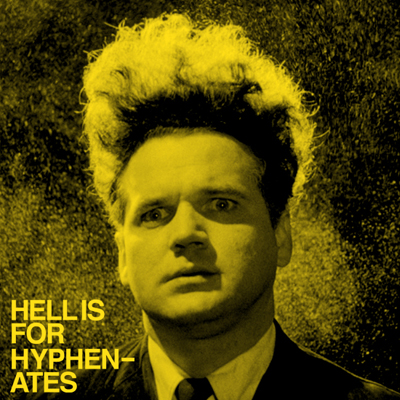
ERASERHEAD (1977) and MULHOLLAND DR. (2001)

David Lynch is one of the great cinematic touchstones. He's somehow both incredibly niche and universally beloved, and that innate contradiction somehow feeds into his films, which are terrifying but not horrific, funny but never comedic, profound but never preachy. But if you've never quite understood the appeal, or have never known where to start, then you’ll want to clear an evening and program the following double. Your evening will kick off with Eraserhead, Lynch's first feature. This is one of the greatest debuts of all time: Lynch immediately created an evocative and unique world that's too weird to be the one we live in, but too familiar to be completely alien. It might seem off-puttingly strange at first to some, but Lynch is dealing with some very familiar emotions here. When you've finished that, jump forward to Mulholland Dr., one of the six or seven films that (along with Eraserhead) could be legitimately called his masterpiece. Mulholland is a tremendous work, and showcases not only his technical accomplishment, but also how brilliantly he works with actors. This is something we tend to forget due to the impossible aesthetics he uses, but Lynch creates potent characters and clearly knows how to get the best out of those who play them. An evening with these two films from either end of his career, and you'll get exactly why everyone adores him.

Substitutions: If you can't get or have already seen Eraserhead, seek out Blue Velvet (1986). This is as big a statement of intent as his first film, a terrifying noir that reveals the darkness of small town suburbia in unique Lynchian style. If you can't get or have already seen Mulholland Dr., his brilliant Lost Highway (1997) will chill you to your bone. In the best way possible, of course.

The Hidden Gem: Want to watch something off the beaten track? Well, The Straight Story (1999) would, in anyone else's filmography, be a fairly “normal” entry. But Lynch's career is an inversion if ever there was one, and this master of sex, violence and terror somehow made a G-rated film for Disney that was as highly regarded as anything else in his oeuvre. This true story of a elderly man travelling three hundred miles on a ride-on mower to visit his estranged brother is beautiful, gentle, and unmistakably Lynchian.

The next episode of Hell Is For Hyphenates, featuring Thomas Caldwell talking David Lynch, will be released on the morning of June 30 (AEST).

Our Next Hyphenate: Thomas Caldwell

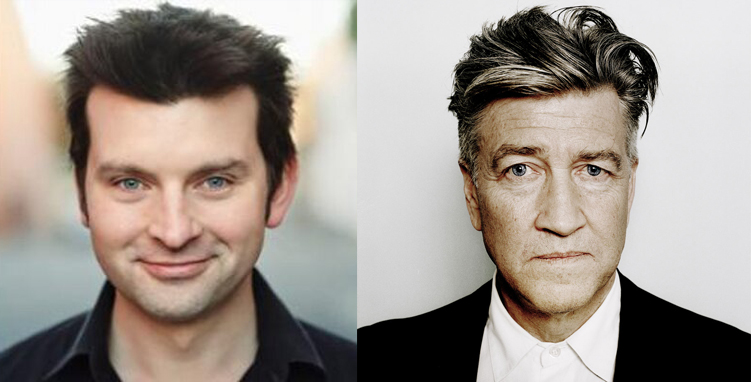
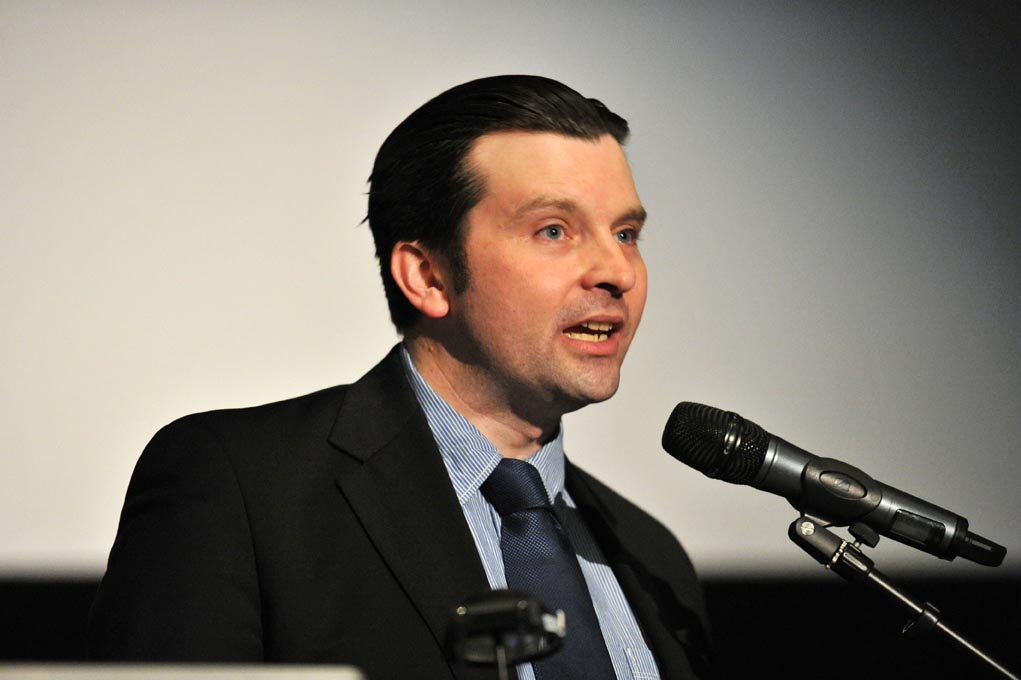
Film critic, festival programmer and June 2015 Hyphenate Thomas Caldwell

Those of you with long memories may recall that Thomas Caldwell has been our guest before. In fact, he was our very first guest back in June of 2010.

We have an unofficial rule on Hyphenates about not repeating guests. This isn't because we don't want to talk to them again - in fact, nearly every recording ends with us wishing we could have that episode’s guest on again the following month - but because our wishlist of potential Hyphenates far exceeds the number of episodes we can reasonably produce. (If you're a filmmaker, film critic, comedian, author, journalist, or even just someone we know, there's a very high chance your name is on that list.)

So why are we having Thomas on again? There are a number of reasons. For one, it's a good way to continue the 5th anniversary celebrations we began last month. Our very first episode released in May of 2010 was never intended to be released to the public, it was just a test run, so we often consider June 2010 to be the first proper episode.

But there's another reason. Thomas was kind enough to help us kick off the show back before anybody (ourselves included) really knew what it was going to be. Back in 2010, we were pitching it more as a “talk about a filmmaker who interests you”, whereas we now lean more on the “pick your favourite filmmaker”.

Thomas chose to talk about Tim Burton on that first episode, and although he was and is a big Burton fan, he did express regret at not going with his number one favourite filmmaker. And this is probably good time to admit that we sometimes use Thomas as a cautionary tale in order to usher people towards their number one pick: “Who would you regret not picking? Which name would make you flinch if someone picked them for a later episode?” The Tale of Thomas Caldwell has been a useful tool for scaring guests.

So when we were thinking of ways to celebrate our 5th birthday, we thought why not have Thomas back on as a thank you of sorts, in order to talk about his undisputed favourite filmmaker?

So we agreed. Let’s break our rule and invite Thomas back to talk about the one and only David Lynch.

Directed by David Lynch

David Lynch is easily one of the most original, uncompromising authorial voices in filmmaking. From his debut Eraserhead to the groundbreaking TV series Twin Peaks and the modern classic Mulholland Drive, Lynch is impossible to easily categorise, having carved out a niche in cinema that's all his own.

He's almost universally beloved amongst film fans, and we're very, very excited to be talking about his incredible works with the biggest Lynch fan we know.

So join us on June 30 as our celebrations continue with this special David Lynch episode!

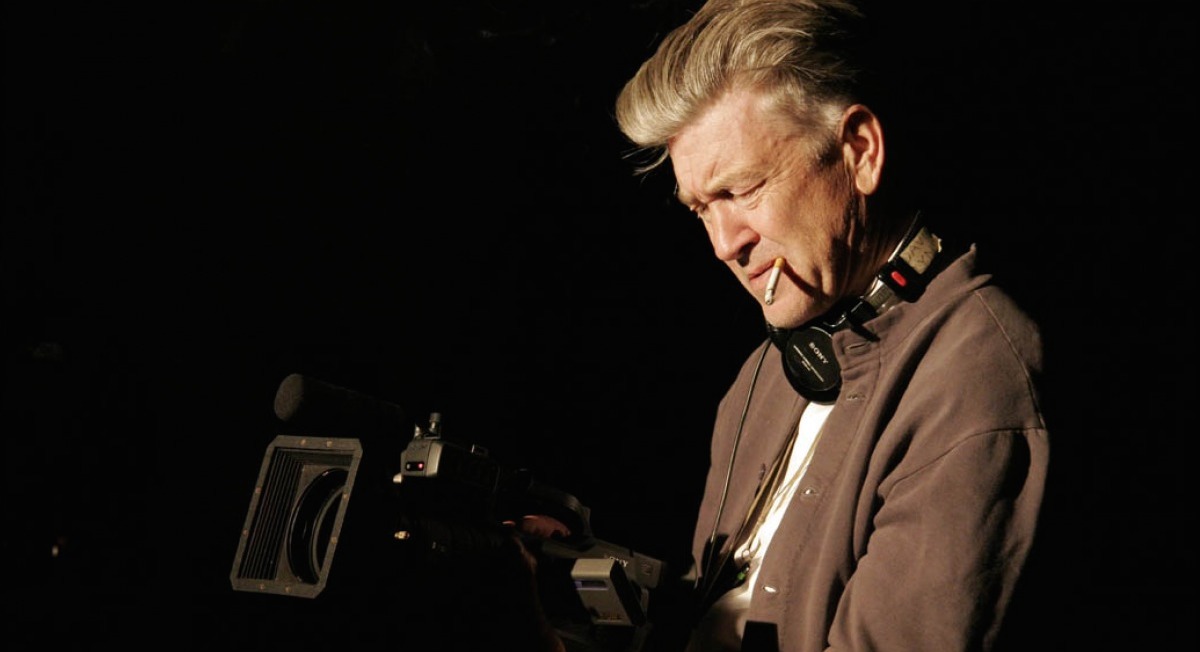
David Lynch
Our next filmmaker of the month, David Lynch

Protosevich On Kobayashi

Protosevich On Kobayashi

Did you know this episode marks the fifth anniversary of Hell Is For Hyphenates? If you didn't before, you do now. So no playing dumb.

Last year when we celebrated our 50th episode (we mark every possible occasion available to us), we noted that it was fitting we do so not with a big-name filmmaker of the month, but rather with someone we hadn't actually heard of before. If this show is all about discovery (and it is), then there's nothing more appropriate.

So it's cool that it's happened again.

We were pretty excited when screenwriter Mark Protosevich agreed to be our guest, and were fascinated by his choice of filmmaker: Masaki Kobayashi.

Other names were bandied about as possibilities, but Mark chose Kobayashi largely because he's a filmmaker who rarely gets his dues. And when we began watching his work, it became clear that we were dealing with one of the all time greats. How is Kobayashi not as big a name in cinema as Kurosawa, his contemporary, colleague and friend?

If, like us this time last month, you're not familiar with Kobayashi's works, then this is the episode for you. We talk the Samurai epic Harakiri, the terrifying ghost story Kwaidan, and one of the most impressive cinematic achievements of all time, World War Two epic The Human Condition.

As always, we begin by reviewing a few key films from the past month, and this time they all reflect our future in some way: Brad Bird's Tomorrowland, George Miller's Mad Max: Fury Road, and Alex Garland's Ex Machina.

But that's not all. Our middle segment this month is one you have to hear if you've ever complained about a screenwriter ever. We look at the way in which writers are credited in Hollywood: complex guild arbitration means that the credited writer may not actually be the one responsible for the script. What seems like an insane system from the outside starts to make sense once you examine it, and there's no one better to talk about this than Mark. We were hoping for a few generalised stories that avoid specifics, but what we got was both candid and eye-opening.

“I have sole credit on that film, but not a single line of dialogue in the film was written by me.”

If you're not a subscriber and only listen to the occasional episode, then this is one you have to hear. And it's not always the done thing to ask for a gift, but if you could swing by iTunes and leave us a positive review, that would be a lovely birthday present.

If you want to brush up on the films of Masaki Kobayashi first, remember to check out our Cheat Sheet here, before listening to the episode here.

Hell Is For Hyphenates – May 2015

Screenwriter Mark Protosevich (The Cell, I Am Legend, Thor, Oldboy) joins the Hyphenates to talk the key films of May 2015, ask how accurate the writing credits on Hollywood productions actually are, and look at the extraordinary films of the underrated Japanese director Masaki Kobayashi.